
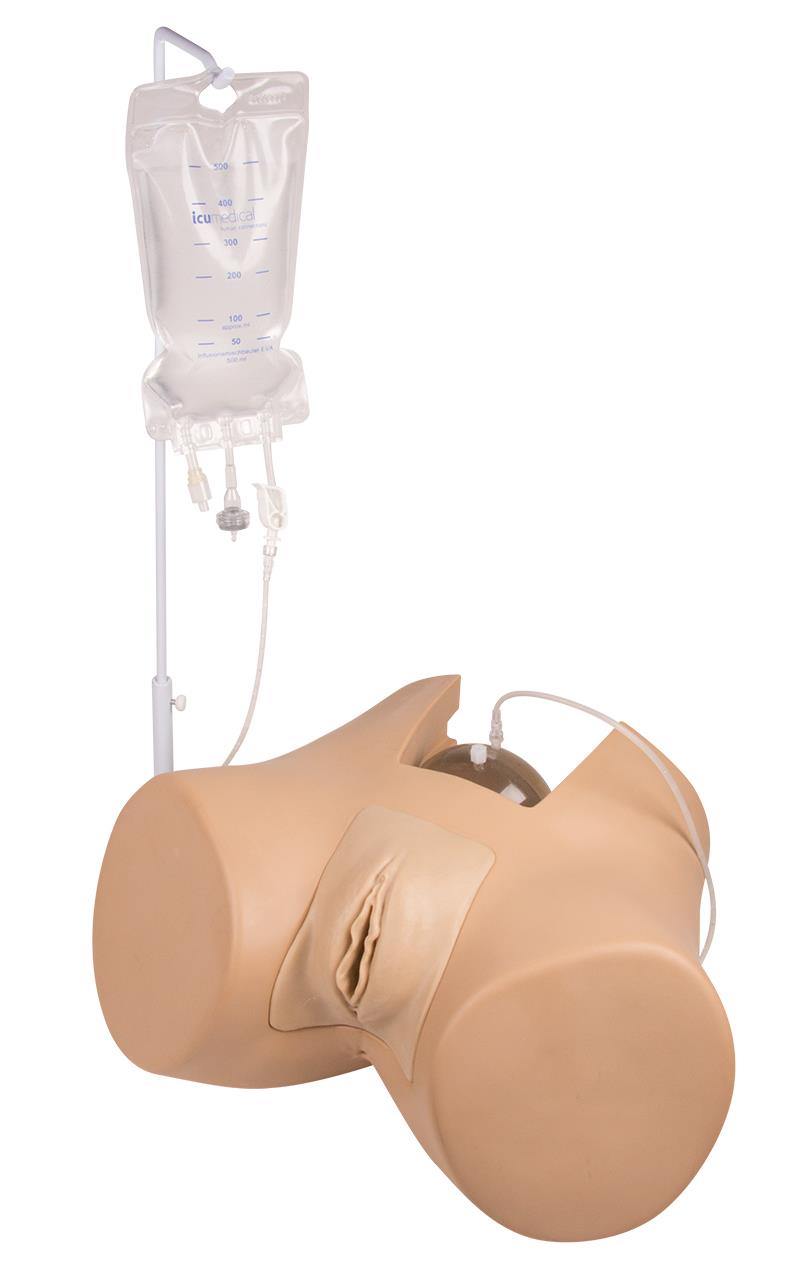
Catheterisation trainers give Australian nursing students a safe, repeatable way to practise urinary catheter insertion before clinical placement. This guide covers the main trainer types, what to look for when selecting equipment, and how to integrate catheterisation practice into a nursing skills lab.
Why Catheterisation Skills Need Dedicated Simulation
Urinary catheterisation is one of the most commonly performed clinical procedures in hospital and aged care settings. It also carries a real risk of harm if performed incorrectly — urinary tract infections, urethral trauma, and patient discomfort are all documented complications of poor technique. For nursing programmes, this creates a clear obligation to ensure students are competent before they encounter real patients.
Simulation-based training addresses this directly. A catheterisation trainer allows students to practise the full procedural sequence — sterile field preparation, correct insertion angle, balloon inflation, and drainage confirmation — without any risk to a patient. Students can repeat the procedure as many times as needed, and educators can observe and correct technique in real time.
In Australia, the Nursing and Midwifery Board of Australia (NMBA) expects graduates to demonstrate competence in a range of clinical procedures. Simulation is widely accepted as a valid pathway to building that competence before supervised clinical practice.
Female and Male Catheterisation Trainers — What Is Available
Most nursing programmes need both female and male catheterisation trainers, as the anatomical differences between the two require distinct technique and equipment. Female trainers typically present the perineal anatomy in a realistic position, with a correctly proportioned urethral meatus and vaginal opening to help students distinguish landmarks. Male trainers replicate the penile anatomy and longer urethra, which requires a different insertion approach and greater attention to angle.
Entry-level trainers focus on the core procedural steps and are well suited to undergraduate nursing programmes. More advanced models include features such as realistic tissue resistance, simulated bladder fill, and interchangeable skin inserts that allow repeated use without degradation. Some trainers are designed as pelvic sections only, while others are integrated into a full lower-body manikin for a more realistic patient encounter.
When selecting trainers, consider whether the model supports both indwelling and intermittent catheterisation, as students will encounter both in practice. Check that the urethral canal is sized to accept standard catheter gauges used in Australian clinical settings.
Key Features to Evaluate Before Purchasing
Not all catheterisation trainers are built to the same standard. The following features are worth assessing before committing to a purchase.
- Tissue realism — soft, skin-like materials that respond to touch in a way that approximates real tissue help students develop appropriate technique and pressure sensitivity
- Durability of the urethral canal — this is the highest-wear component; look for replaceable inserts or reinforced construction
- Balloon inflation feedback — the trainer should allow students to inflate the retention balloon and confirm correct placement before withdrawing
- Drainage simulation — models that allow simulated urine flow give students confirmation of correct placement, which is an important step in the clinical procedure
- Cleaning and maintenance — trainers used repeatedly by multiple students need to be easy to clean and resistant to common disinfectants
- Compatibility with standard consumables — the trainer should accept the same catheter sizes and drainage bags used in clinical practice, so students train with real equipment
Integrating Catheterisation Trainers into a Skills Lab Programme
A catheterisation trainer is most effective when it is embedded in a structured learning sequence rather than used as a standalone activity. A typical approach begins with a demonstration by the educator, followed by guided practice where students work through each step with feedback, and then independent practice where students complete the procedure without prompting.
Objective structured clinical examinations (OSCEs) are commonly used in Australian nursing programmes to assess procedural competence. Catheterisation is a frequent OSCE station, and students who have practised on a trainer consistently perform better than those who have not. Building regular trainer sessions into the curriculum — rather than treating them as a one-off activity — produces more durable skill retention.
For programmes with limited lab time, consider pairing catheterisation trainers with catheterisation simulation resources that allow students to review procedural steps independently before their scheduled lab session. This frees up supervised time for practice and feedback rather than instruction.
Procurement Considerations for Australian Nursing Schools
Catheterisation trainers range from basic pelvic models to comprehensive simulation systems. For most undergraduate nursing programmes, a mid-range trainer that covers both female and male anatomy, supports balloon inflation, and includes drainage simulation will meet curriculum requirements without unnecessary cost.
When calculating how many trainers to purchase, a common benchmark is one trainer per two to three students during a scheduled lab session. This allows adequate practice time without long wait periods. If your programme runs multiple cohorts through the same lab, factor in cleaning time between groups when scheduling.
Consumables — catheters, drainage bags, lubricant, and sterile drapes — add to the ongoing cost of running catheterisation labs. Some institutions negotiate supply agreements with clinical consumables providers to reduce per-session costs. It is worth confirming that the trainers you select are compatible with the consumables your institution already stocks.
For institutions equipping a new skills lab or expanding an existing one, browsing the full range of medical simulators available in Australia can help identify complementary equipment — such as injection trainers, patient care manikins, and advanced life support trainers — that can be purchased together to reduce freight costs.
Catheterisation Training in Aged Care and Community Nursing Contexts
Catheterisation is not limited to acute hospital settings. Aged care nurses and community nurses regularly perform catheter insertions and changes in residential and home settings, often without immediate access to senior clinical support. This makes pre-placement simulation training particularly important for students entering these sectors.
Programmes that prepare students for aged care or community nursing roles should ensure their catheterisation training covers not just the technical procedure but also patient communication, dignity considerations, and the management of complications such as bypassing or blockage. A realistic trainer supports the technical component; the communication and assessment elements require structured scenario design around the simulation activity.
The patient care trainer range includes manikins and task trainers suited to aged care and community nursing education, and can be used alongside catheterisation trainers to build a more complete simulation scenario.
When purchasing catheterisation trainers for an Australian institution, look for a supplier that can provide product demonstrations, clear documentation on materials and maintenance, and responsive after-sales support. Trainers that develop faults mid-semester can disrupt scheduled lab sessions, so knowing that replacement parts or repairs are accessible is important.
If your programme is planning a larger equipment purchase, a formal quote process allows you to compare options and negotiate on price and delivery. The quote request process is straightforward and allows institutions to specify quantities, model preferences, and delivery requirements in a single submission.
Catheterisation trainers are a long-term investment. A well-maintained trainer used across multiple cohorts delivers good value per student contact hour, and the procedural competence it supports has a direct impact on patient safety outcomes in clinical settings.