Patient care manikins give Australian nursing and aged care students a safe, repeatable way to practise fundamental care skills before working with real residents or patients. Choosing the right manikin depends on your programme level, the skills you need to assess, and your available budget.
What Are Patient Care Manikins and Who Uses Them
Patient care manikins are full-body or partial-body training models designed to simulate a dependent adult patient. They are used in Certificate III and IV in Individual Support programmes, Bachelor of Nursing curricula, and in-service training for aged care workers. Unlike high-fidelity simulation manikins that replicate physiological responses, patient care manikins focus on manual handling, hygiene, repositioning, and basic clinical observations.
In Australia, the aged care sector faces ongoing workforce pressures, and registered training organisations (RTOs) and universities are under increasing pressure to graduate students who are work-ready from day one. Patient care manikins are a practical, cost-effective way to build that readiness without placing inexperienced students in direct contact with vulnerable residents.
Core Skills Patient Care Manikins Support
A well-specified patient care manikin can support a wide range of foundational competencies. The most common include
- Bed bathing and personal hygiene care
- Repositioning and pressure injury prevention
- Manual handling and safe patient transfers
- Oral hygiene and feeding assistance
- Blood pressure measurement and basic vital signs observation
- Catheter care and continence management
- Wound dressing and skin integrity assessment
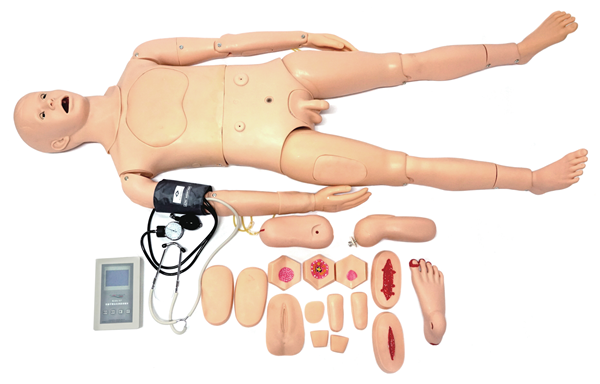
Some manikins include functional features such as a blood pressure measurement arm, realistic skin texture, or articulated joints that respond to correct manual handling technique. These features increase the fidelity of practice sessions and help students build correct habits before clinical placement.
How to Match a Manikin to Your Programme Level
Not every programme needs the same level of manikin. For Certificate III in Individual Support, a basic adult manikin with realistic weight and articulated limbs is usually sufficient. Students at this level are learning foundational hygiene and repositioning tasks, and a straightforward model supports those objectives without unnecessary complexity.
For Bachelor of Nursing or enrolled nursing programmes, a manikin with additional clinical features — such as a blood pressure arm, catheterisation capability, or wound care sites — gives students more opportunities to practise within a single session. This reduces the number of separate task trainers a programme needs to purchase and maintain.
For in-service aged care training, portability matters. A manikin that can be transported between facilities or used in a community setting without specialist equipment is more practical than a large, fixed simulation station.
Key Features to Evaluate Before Purchasing
When comparing patient care manikins, focus on the features that directly support your assessment tasks. Weight and dimensions should reflect a realistic adult patient — a manikin that is too light will not give students an accurate experience of manual handling. Skin texture and joint articulation affect how realistic hygiene and repositioning tasks feel in practice.
Durability is a practical concern for high-use training environments. Manikins used in RTOs and university skills labs are handled by many students across multiple cohorts. Look for models with replaceable skin panels or modular components that can be serviced without replacing the entire unit.
Cleaning and infection control are also important. Manikins used in aged care training should have smooth, non-porous surfaces that can be wiped down between sessions. Check whether the manufacturer provides guidance on compatible cleaning agents, as some materials degrade with repeated use of alcohol-based products.
Budget and Procurement Considerations for Australian Institutions
Patient care manikins range from entry-level models suited to basic skills training through to feature-rich units that support a broader range of clinical tasks. For most RTOs delivering Certificate III or IV programmes, a mid-range manikin with realistic weight, articulated joints, and a basic clinical feature set represents good value.
Australian institutions purchasing training equipment may be eligible for funding through state and territory vocational education and training (VET) grants or through the Australian Government's Skills and Training Incentive programmes. It is worth checking current eligibility criteria with your state training authority before finalising a purchase.
When budgeting, factor in consumables and maintenance. Some manikins require replacement skin panels, lubricants, or cleaning kits. A slightly higher upfront cost for a durable, well-supported model often results in lower total cost of ownership over a three-to-five-year period.
For institutions equipping a new skills lab or refreshing ageing stock, requesting a quote for multiple units at once can reduce per-unit cost. The Anatomy Store offers a quote request service for institutional buyers, which is useful when comparing options across a range of manikins and task trainers.
Integrating Patient Care Manikins into Your Skills Lab
A patient care manikin is most effective when it is integrated into a structured skills lab programme rather than used as a standalone resource. Pair manikin practice with scenario-based learning — for example, a simulated morning care routine that requires students to complete hygiene, repositioning, and vital signs observation in sequence. This mirrors the workflow students will encounter in a real aged care or hospital setting.
Assessment using a manikin should be structured around the same competency standards students will be assessed against in clinical placement. In aged care, this means aligning practice tasks with the Aged Care Quality Standards and, for nursing students, with the Nursing and Midwifery Board of Australia's registration standards.
Complement manikin practice with anatomy models that help students understand the underlying structures they are working with — for example, a pelvis model when teaching catheter care, or a skin model when teaching wound assessment. This combination of procedural practice and anatomical understanding produces better-prepared graduates.
For programmes that also need to teach injection technique, venipuncture, or other procedural skills, medical simulators can be used alongside patient care manikins to build a comprehensive skills lab without duplicating equipment. Browse the full range at The Anatomy Store shop to find options suited to your programme and budget.