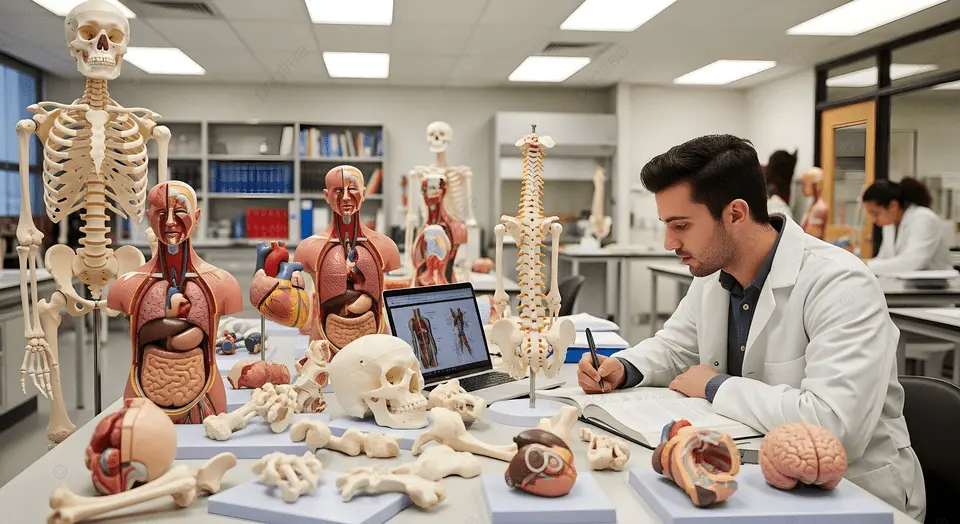
Anatomical skeleton models are one of the most widely used teaching tools in healthcare education. Whether you are setting up a university anatomy lab, equipping a physiotherapy clinic, or running first aid courses, the right skeleton model can transform how students learn the musculoskeletal system.
But with hundreds of options on the market — from desktop miniatures to full-size clinical models with flexible spines and muscle markings — choosing the right one is not always straightforward.
How Many Bones Are in the Human Body?
The adult human skeleton contains 206 bones, divided into two main groups. The axial skeleton (80 bones) includes the skull, vertebral column, and thoracic cage. The appendicular skeleton (126 bones) includes the shoulder girdles, upper limbs, pelvic girdle, and lower limbs.
At birth, humans have roughly 270 bones. Many of these fuse during development, reaching the standard 206 by early adulthood. A quality teaching skeleton should represent all 206 bones with anatomically accurate proportions and landmarks.
Types of Skeleton Models
Basic Teaching Skeletons are full-size, articulated models suitable for general anatomy instruction. They typically feature a removable calvarium (skull cap), moveable jaw, and articulated limbs. These are the workhorse of most anatomy labs.
Flexible Spine Skeletons include a wire-mounted vertebral column that allows realistic spinal flexion, extension, and lateral bending. These are particularly valuable for physiotherapy, chiropractic, and osteopathy programs where spinal mechanics are central to the curriculum.
Muscle-Origin-and-Insertion Skeletons have painted markings showing where muscles attach to bone. This makes them excellent for kinesiology and sports science courses, where understanding muscle action is as important as knowing the bones themselves.
Ligament Skeletons add flexible, colour-coded ligament structures to the joints. These are ideal for orthopaedic training and rehabilitation education, where understanding joint stability and range of motion is essential.
Miniature and Desktop Models are scaled-down versions (typically 85cm or half-size) designed for personal study, small clinics, or demonstrations where a full-size model is impractical.
What to Look For
When evaluating a skeleton model, consider these factors in order of importance for your use case.
Anatomical accuracy is non-negotiable. Look for models that faithfully reproduce bony landmarks, foramina, and articular surfaces. Cheaper models often cut corners on small structures like the styloid processes or sacral hiatus.
Articulation quality matters for longevity. Metal joints with wire connections tend to last longer than plastic snap-fit designs, especially in high-traffic teaching environments where students are constantly posing the model.
Mounting options are worth considering. Most full-size skeletons come with a rolling stand, but wall-mount and hanging options exist for spaces where floor space is limited.
Detachable parts increase versatility. Models with removable arms, legs, and skull components allow students to examine structures up close without wrestling with the full skeleton.
Real Bones vs Synthetic Models
Historically, real human skeletons were used extensively in medical education. Today, the ethical, legal, and logistical challenges of sourcing real specimens have made high-quality synthetic models the standard in most Australian and New Zealand institutions.
Modern resin-cast models replicate the weight, texture, and surface detail of real bone with remarkable accuracy. For most teaching applications, a well-made synthetic skeleton is indistinguishable from a real specimen in terms of educational value — and far easier to maintain, store, and replace.
Price Ranges
Budget expectations vary significantly depending on what you need.
- Desktop / miniature models — $50 to $200
- Basic full-size teaching skeletons — $300 to $600
- Professional models with flexible spine — $600 to $1,200
- Specialist models (muscle markings, ligaments, pathologies) — $800 to $2,000+
For institutional buyers, we offer tailored pricing on bulk orders. Request a quote for volume discounts.
Our Recommendation
For most Australian education settings, a full-size skeleton with a flexible spine and painted muscle origins/insertions offers the best value. It covers the widest range of teaching scenarios — from basic anatomy through to advanced musculoskeletal assessment — without needing multiple specialist models.
Browse our full range of skeleton and anatomy models or contact our team for advice on the best fit for your program.