Trauma simulation trainers give Australian emergency nursing and paramedicine programmes a safe, repeatable way to practise haemorrhage control, wound assessment, and emergency response before students encounter real patients. The right equipment depends on your programme's scope, student numbers, and the clinical competencies you need to assess. This guide covers the main trainer types, what to look for when selecting equipment, and practical advice for procurement teams.
Why Trauma Simulation Matters in Emergency Nursing Education
Emergency nursing requires rapid decision-making under pressure. Students who have only read about haemorrhage control or wound packing in a textbook are less prepared than those who have practised the skill repeatedly on a realistic trainer. Simulation allows educators to create controlled, repeatable scenarios — a penetrating wound, a heavily bleeding limb, a pressure injury — without relying on clinical placement availability or patient consent.
Australian nursing programmes are increasingly expected to demonstrate that graduates have met defined clinical competency standards before entering the workforce. Trauma simulation trainers provide a documented, assessable way to meet those expectations. They also reduce the cognitive load on students during their first real clinical encounters, because the physical skill is already embedded.
For rural and remote programmes where clinical placement opportunities are limited, simulation equipment is not a supplement — it is often the primary means of skills development.
Main Types of Trauma Simulation Trainers
Trauma trainers range from simple wound moulage overlays to sophisticated bleeding limb simulators. Understanding the categories helps you match equipment to your curriculum objectives.
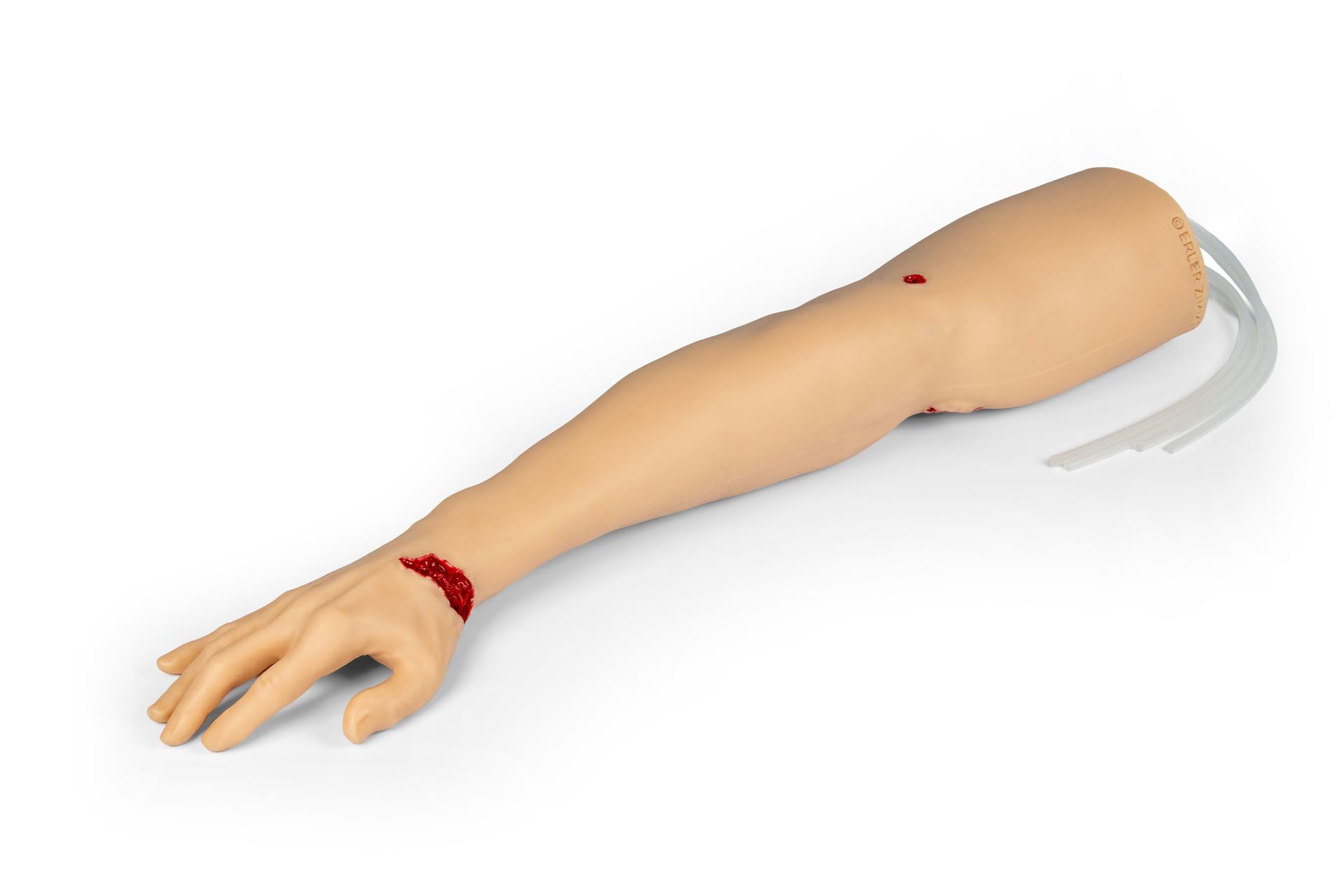
- Bleeding wound trainers — Realistic arm or limb models that simulate active haemorrhage. Students practise tourniquet application, wound packing, and pressure bandaging. Some models use artificial blood to increase realism.
- Wound moulage overlays — Silicone or foam overlays applied to a manikin or task trainer to simulate specific wound types, including lacerations, burns, pressure injuries, and puncture wounds. Useful for assessment scenarios where visual realism matters.
- Trauma task trainers — Standalone partial-body trainers focused on a specific skill, such as chest decompression, wound irrigation, or tourniquet placement. These are typically more affordable than full-body manikins and easier to store.
- Full-body trauma manikins — High-fidelity simulators that combine multiple trauma features — bleeding wounds, airway management, vital sign monitoring — in a single platform. These are suited to advanced simulation centres running complex multi-casualty scenarios.
Most Australian nursing programmes start with task trainers and wound overlays, then add bleeding simulators as budgets allow. Full-body trauma manikins are typically found in university simulation centres and hospital education departments rather than smaller TAFE or vocational programmes.
What to Look For When Selecting Trauma Trainers
Not all trauma trainers are equally suited to every programme. These are the features worth evaluating before purchasing.
Realism of wound representation. Students learn more effectively when the trainer looks and feels close to real tissue. Silicone wound overlays and trainers with realistic skin texture produce better skill transfer than foam or plastic alternatives. Look for models that represent the wound types your students will encounter — lacerations, puncture wounds, pressure injuries, or blast injuries depending on your programme focus.
Durability and maintenance requirements. Trauma trainers take significant wear. Wound packing trainers in particular need to withstand repeated insertion and removal of gauze. Check whether replacement wound inserts are available and what the expected lifespan of consumable components is. Trainers with replaceable wound modules are more cost-effective over time than those requiring full unit replacement.
Compatibility with artificial blood. Some programmes use artificial blood to increase scenario realism. Confirm that the trainer is designed for use with fluid and that cleaning is straightforward. Trainers not rated for fluid use can degrade quickly if artificial blood is introduced.
Storage and portability. If your programme runs simulation in multiple locations — a skills lab, a clinical placement site, or an outdoor scenario space — consider how easily the trainer can be transported and stored. Partial-body task trainers are generally more portable than full-body systems.
Curriculum Alignment for Emergency Nursing Programmes
When selecting trauma simulation equipment, map your purchases to the specific competencies in your curriculum rather than buying broadly. Australian nursing programmes typically assess haemorrhage control, wound assessment, and emergency response as discrete competencies. Each of these maps to a different type of trainer.
Haemorrhage control competencies — tourniquet application, wound packing, pressure bandaging — are best assessed on a bleeding limb trainer that allows students to apply real force and technique. Wound assessment competencies benefit from a range of wound moulage overlays that represent different wound types and stages of healing. Emergency response scenarios that involve multiple casualties are better suited to full-body manikins or a combination of task trainers used simultaneously.
Aligning equipment to specific competency outcomes also makes it easier to justify procurement decisions to department heads and finance teams. A clear mapping between equipment and assessed outcomes is more persuasive than a general argument for simulation.
You can browse the full range of trauma simulation trainers available through The Anatomy Store to see what suits your programme's scope.
Procurement Considerations for Australian Institutions
Trauma simulation equipment varies considerably in price, and procurement processes at Australian universities and TAFE institutes often require multiple quotes or panel approval for purchases above a threshold. Planning ahead reduces delays.
Consider the following when preparing a procurement case.
- Total cost of ownership — Include consumables (wound inserts, artificial blood, replacement skin overlays) in your budget estimate, not just the upfront unit cost.
- Warranty and support — Confirm the warranty period and whether the supplier offers local support or repair services. Equipment that fails mid-semester with no local support option creates significant disruption.
- Scalability — If your student cohort is likely to grow, consider whether the equipment can scale. Multiple identical task trainers are often more practical than a single high-fidelity unit when you need to run concurrent student groups.
- Supplier reliability — Choose a supplier with a track record of supplying Australian educational institutions and who can provide references or case studies from comparable programmes.
If your programme requires a formal quote before purchase, The Anatomy Store offers a quote request service for institutional buyers. This can simplify the procurement process for programmes that need documented pricing before seeking approval.
Integrating Trauma Trainers into Your Skills Lab
Purchasing trauma simulation equipment is only the first step. How you integrate it into your skills lab and curriculum determines how much value it delivers.
Scenario-based learning produces better outcomes than isolated skill drills. Rather than having students practise tourniquet application in isolation, build scenarios that require them to assess the situation, prioritise interventions, and communicate with a team — then apply the physical skill. This mirrors the conditions of real emergency nursing practice.
Debriefing after simulation sessions is as important as the simulation itself. Students who reflect on what they did, why they did it, and what they would do differently retain skills more effectively than those who simply repeat the drill. Build structured debriefing time into your session plans.
For programmes that are new to trauma simulation, starting with a small set of task trainers and building complexity over time is more sustainable than investing in a full simulation suite immediately. A bleeding wound trainer and a set of wound moulage overlays can support a wide range of scenarios at a manageable cost.
Browse the full range of medical simulators available through The Anatomy Store, or contact the team to discuss which trainers are best suited to your programme's needs and budget.